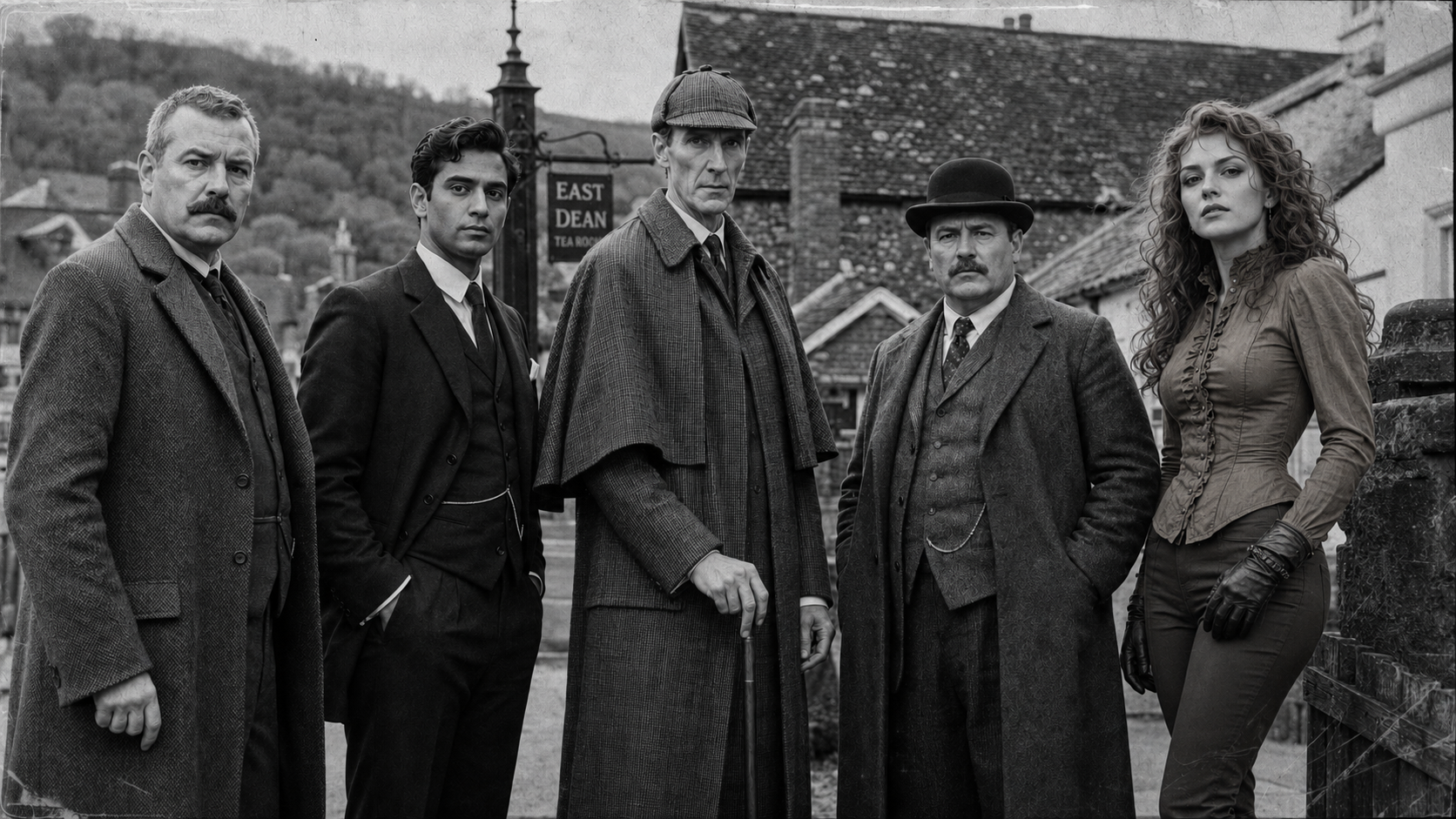
1
The sirens went off in HM Prison Dartmoor. Several moments too late. The escape was incomprehensible and unlikely. A tunnel. Yet it had happened. John Clay aka Vincent Spaulding, master bank robber had escaped. His imprisonment following the strange affair of the Red-Headed League had long since faded from the public memory. Tunnels had been his calling card in the robberies. Yet, this was as improbable an escape as any. Pursuit cars were shortly dispatched. Directionless. In every direction.
Lestrade groaned. Not because of the emergency telephone call. As he dragged his body out of bed, no longer the young man who could outrun and outfox England’s worst, his brain told him quite harshly to just ignore the insistent ringing and to go back to sleep. It was cold. However, he wasn’t built like that.
‘John Clay has escaped Sir,’ said the voice at the other end of the line.
‘Who is John Clay?’
‘The man you got for the redheaded league case Sir, some years ago. John Clay Sir, you may remember him as Vincent Spaulding’
‘I did not catch him. I made the arrest. Did you just wake me to tell me that?’
‘No Sir, it is just… it is just…’
‘Get on with your message, Battle!’
‘Colonel Sebastian Moran escaped with him.’
Lestrade felt the back of his neck grow cold. For a few seconds he did not speak.
‘Sir? Sir, are you there on the line? I cannot hear you. Sir?
‘I am here, Battle. Get the word out. Call every county,’ he paused, ‘Sussex Downs. Inform Eastbourne first. Inform East Dean. Tell all the superintendents. I will keep the home secretary informed myself.’
‘Eastbourne and East Dean first, Sir? On it.’
‘Hurry, Battle,’ said Lestrade and hung up the phone. It was not a night to sleep. He had to call on someone first. He heard the patter of the rain against the windows. He gritted his teeth. The rain and the cold.
‘Just the usual,’ he reminded himself. He walked out of his apartment and hailed the lone cab on the street.
‘Spitalfields, my good man.’
A Morris Oxford Flatnose was speeding towards East Dean. It was still pitch-black. Starless. The fog made top speed impossible. On the steering wheel, John Clay was vigilant, his eyes wide open.
‘Did you arrange the weapon I need?’ asked the old man sitting next to him. His voice was raspy.
‘It has been arranged. Colonel Moran,’ replied John Clay. ‘A contact in Steyning will hand it over.’
‘He had better…there is not much time,’ snarled Colonel Sebastian Moran.
John Clay was not afraid of many men. He was, however, terrified of the white-haired man sitting next to him now in the front seat of the car. He did not show it but his voice betrayed a tremor or two whenever he had to reply. This man had enabled an impossible escape. How did no one at that infernal prison notice the digging? The tunnel? Clay was a reasonable man, a clever man. He knew this escape owed nothing to his own ingenuity.
The Colonel. He had heard about him. Former soldier, whose military career had ended in disgrace amid allegations of unspeakable brutality on the North-West Frontier of the Indian subcontinent. Known as a sharpshooter. Rumoured killer of many politicians and bureaucrats, a close associate of the Late Professor Moriarty. No killings had ever been proven but his crimes were serious enough that the remotest jail in England has been his home for over two decades.
Clay was not going to ask any questions. He was free but he had to fulfil an obligation. The pickup of a weapon. The drive to East Dean. He would drop the Colonel at an address. Then, it was just the open road.
2
Dorset Street in Spitalfields was witnessing an unusual night. Not the moans of the famished children tonight, nor the anguished cries of women. Even the cold and the rain seemed stripped of their power.
A Bentley stood at the end of the street. Two large trucks stood next to it. Three large men were pulling out crates of bread, potatoes, meat and eggs from it. And crates of chocolates. They were taking directions from an Indian man in a suit.
The women and children were peeking out of their windows and doors. The men could barely stand in queue as instructed. On another night, they might not have.
However, the woman who stood at the end of the street by the truck seemed to be commanding serenity by her mere beauty. It was not just her beauty though. Behind her stood another man in an overcoat whose face was not fully visible and around whom the light of the solitary street lamp seemed to be reflecting a miasma of colours. Perhaps it was because of this strange effect of light that the tall and red-haired woman looked like she had stepped out of a painting at a place of worship. Her riding boots and effortless bearing suggested an upbringing unfamiliar to Dorset Street. She was dressed in a frilly but exquisitely embroidered orange shirt tucked into brown trousers.
The orderly distribution of food continued. Some children could not help themselves and ran to the woman. The boys got chocolates and a pat on the head. The girls got chocolates and hugs.
‘Lady Wickham, it is an overwhelming feeling, is it not?’ asked the man who stood behind her.
‘Yes…I feel extraordinary elation and shame at the same time.’
‘There is no shame in doing one kind of right. You have made a start here. That is the most important thing. You have already done other kinds of right Lady Wickham.’
Bobbie Wickham looked at him. She had stopped asking herself why it was that whenever she looked at him, she felt as if she was seeing him for the first time.
‘Yes, Bertram would have loved this too. Why did you insist that I not bring him here?’
‘You have brought incredible joy to his innocent heart, but let him find his own causes.’
She turned to look at Sir Shash who was directing the distribution of food and then she looked at Mr. Quin again.
‘And Shash? Did you let him find his own causes?’
‘I did not bring him to anything Lady Wickham. I have just… run into him, and how fortunate that I should interact with someone as interesting as yourself because of my association with him. Now, I beg your pardon, I must take your leave. I believe I am expected elsewhere.’
Lady Roberta watched as Mr. Quin nodded a polite bow and walked away.
Just then a hansom pulled up. Lestrade jumped out. He waved at Sir Shash.
‘Sir Shash, I must say I am relieved to find that you are exactly where you said you would be this night,’ he stopped as he had just noticed Lady Roberta Wickham.
He uttered a formal greeting and said ‘Lady Wickham, I suppose it is futile for me to suggest that this is no place for you on a night such as this.’
Bobbie Wickham smiled and said, ‘That is right, Chief Lestrade. It is futile.’
Sir Shash walked up to Lestrade now. They shook hands.
‘I have some unfortunate news,’ he said.
3
Dr Watson was forced to open his eyes when the phone would not stop ringing. He had been awake for some time already and despite the melancholic notes of the violin emanating from the living room, he had been trying to will himself to sleep. Over the decades, he had become completely accustomed to Holmes’s violin practice at odd hours. He could mostly sleep through it. The telephone’s cacophony, however, was too much to ignore. He put a robe and ambled out to the corridor.
He picked up the phone and listened to Inspector Battle’s urgent message. He thanked him briefly and went to the living room. The master detective sat on his favourite chair, his back comforted by the modern cushions that he would have once abhorred. He had just ended a tune. Sherlock Holmes smiled gently and said, ‘My dear Watson, you always tell me that my indulgences with the violin no longer keep you up. Yet, here you are. I apologise my dear friend.’
‘Oh, come on Holmes, you know it was not the violin. It was the telephone.’
‘Was it Lestrade or was it someone playing a prank? I gather it was the former for you seemed to linger on the phone a bit and you were quite sober in your goodbye.’
‘It was Inspector Battle, do you know of him?’
‘Yes, he is a prodigious talent, Lestrade had spoken well of him once. I heard his name mentioned by our Belgian friend.’
‘Then I suppose, I should worry a lot more.’
‘Tell me Watson, who is it that we should worry about? Or is it a consultation he seeks?’
‘Colonel Moran has escaped from Dartmoor with John Clay. I suppose you remember them both?’
‘My dear fellow, John Clay was a smart mind entirely devoted to the art of the heist. Had he ever put his brains to good use, he could have been an asset to the police force. I had however, never once thought that I would hear his name mentioned in the same breath as Colonel Moran. Unfortunately, he has now crossed a line from where there is no return. A life completely wasted.’
‘Holmes!’
‘My dear fellow, I see that look on your face. Do not think that I have lost all my faculties. Moran is on his way here. Two decades, he has plotted his revenge. He wants to kill me. Maybe, he wants to kill you too. I know what he is. He was the second most dangerous man in England and an unparalleled marksman. He ages too Watson. He ages too.’
‘Holmes, Battle says he is getting a clearance to have two men watch this house. However, he has suggested that we make arrangements to move to London immediately where it will much safer. He has given me the address of what he calls a ‘safehouse’. He says once we reach there, his men will see to it that we are well protected.’
Holmes gave a wry smile.
‘I see nothing to smile about, Holmes.’
‘Watson, some years ago, you would have pulled out a pistol and waited for him.’
‘I would have died then and we shall die now if we do not protect ourselves.’
‘You should get a few hours of sleep Watson. Unless there is an automobile invention that we do not know of, he cannot reach here before morning. While it is possible that he takes a shot at me tomorrow, during the day, I believe he would wait for the dark. He could shoot just as well in the dark. Why am I rambling? What I meant was, I will stay here.’
‘You cannot be dismissing danger so casually Holmes. Why, you were much more circumspect when you orchestrated his capture!’
‘Hah! Not incorrect, my dear fellow. The asthma, the bone aches, the gradual creeping up of this irreversible brain fog, this body is now practically useless. No, no, I am not suicidal nor do I have what the scandal sheets call ‘a death wish.’ I will not run like a rat. It has been a useful life; I should like to think Watson. Death cometh soon or late. What better way to plan an exit than facing fearful odds?’
‘Holmes, I will not have you quote Horatius at me. I know I cannot physically make you leave. You have never listened to my viewpoint my dear friend. I have listened to you my entire life. Just this once, let me decide.’
‘You wound me Watson, you were the only one I ever let in on all my triumphs and all that I considered my personal failures. You were my chronicler. Will you write one last story about how we ran from Colonel Moran? I think not. What would Mrs Hudson say?’
‘Mrs Hudson, God be with her, was a person with plenty of common sense, Holmes. I knew…’
The phone was ringing again. Dr Watson hurried to it. A minute later, he was back in the living room.
‘Well?’ the great detective’s voice was expectant.
‘That was Lady Roberta Wickham. It seems she plans to drive here from London.’
Holmes chuckled and said, ‘There you go Watson, even the aristocrats seem to have the same point of view as I have.’ He picked up the violin again.
Dr Watson sat down, a resigned look on his face. Perhaps it was the strain, perhaps it was the music from the violin, but he was soon fast asleep.
Leave a Reply